
PP Midsole vs Cardboard Insole Board: The Short Answer
Injection-moulded polypropylene (PP) midsoles are usually the stronger choice for high-volume footwear production that needs low water absorption, repeatable dimensions and fewer manual cutting steps. Traditional cellulose or cardboard insole boards remain practical when breathability, moisture absorption, low tooling cost and frequent style changes matter more.
Neither material is universally better. The right choice depends on the shoe construction, target market, production volume, bonding system and the comfort layers used above the structural board.
Terminology note: Depending on the market, this component may be called a PP midsole, PP insole board, lasting board or structural insole. In this article, "cardboard" means a purpose-made cellulose footwear board, not ordinary packaging board.
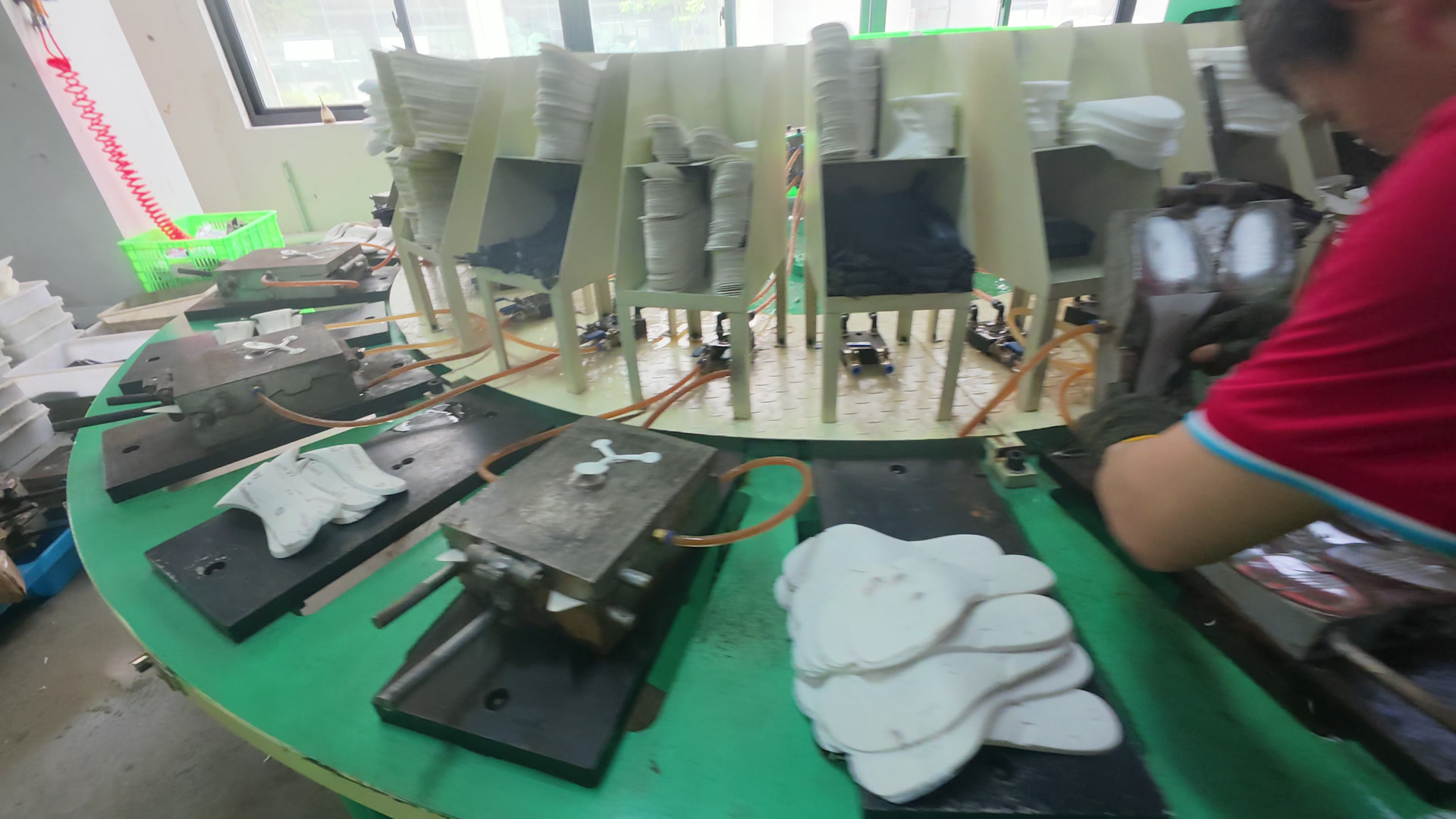 DY-1124-PP rotary production line manufacturing PP midsoles
Quick Comparison
| Factor | Injection-moulded PP midsole | Cellulose/cardboard insole board | |---|---|---| | Water absorption | Very low | Absorbs moisture unless a water-resistant grade or coating is used | | Dimensional consistency | Geometry is controlled by the mould | Depends on sheet quality, cutting and later processing | | Production method | Injection moulding with dedicated moulds | Sheet cutting, skiving, shaping and assembly | | High-volume output | Well suited to continuous, repeatable production | Can require more separate operations and labour | | Small orders and style changes | New sizes or designs may require mould investment | Easier to cut new patterns from sheet stock | | Moisture management inside the shoe | Usually needs a suitable top cover or lining | Cellulose can absorb perspiration and contribute to foot comfort | | Bonding | PP is a low-surface-energy plastic; adhesive selection or surface treatment matters | Generally familiar to footwear factories and often easier to bond | | Best fit | Wet-use footwear, sandals, slippers and repeat high-volume programs | Many closed shoes, flexible production and lower-volume style changes |
Why Traditional Cellulose Insole Board Is Still Widely Used
Cellulose insole board has a long record in footwear manufacturing because it combines stiffness, controlled flexibility, machinability and moisture absorption. A European Commission-supported research project described cellulose board as widely used in shoe manufacture and noted that its moisture absorption can contribute to wearer comfort.
Modern footwear board is also more advanced than the word "cardboard" suggests. Suppliers offer different stiffnesses, flex directions, thicknesses and water-resistant grades. Recycled fibre can form a substantial part of the material. For factories producing many styles in modest quantities, sheet material can be economical because patterns can be changed without manufacturing a complete injection mould set.
Its main limitation is moisture sensitivity. The same cellulose structure that absorbs perspiration can retain water. Under demanding wet conditions, retained moisture can contribute to loss of mechanical performance or biological deterioration unless the board is formulated or coated for that environment.
What Changes with an Injection-Moulded PP Midsole?
Polypropylene is a hydrophobic thermoplastic. Published PP technical literature reports very low 24-hour water absorption, typically around 0.02-0.03 percent under ASTM D570 test conditions. This does not make every finished shoe waterproof, but it means the PP structural component itself is far less affected by water than an untreated cellulose board.
Injection moulding also changes the production logic. Instead of cutting each component from a sheet, molten PP fills a defined cavity. Once the material, mould, temperature, pressure and cooling cycle are stable, the process can produce repeatable outlines, thickness zones and locating features from cycle to cycle.
 DY-1124-PP injection unit and rotary worktable
Five Practical Advantages of PP for Suitable Products
1. Better resistance to wet production and wet-use conditions
Low water absorption helps the structural part retain its dimensions when exposed to humidity, water or repeated cleaning. This is particularly relevant to slippers, sandals and other products likely to encounter wet floors or humid climates.
2. Consistent geometry from a controlled mould
The mould defines the component shape. This can reduce variation caused by manual cutting and make alignment easier in later footwear assembly. The benefit is strongest when the factory has stable process settings and disciplined mould maintenance.
3. Efficient output for repeat orders
The DY-1124-PP is designed for single-colour PP midsole production with a multi-station rotary workflow and water-cooled moulds. Depending on mould layout, part size, cooling requirements and cycle settings, its typical production range is 280-400 pairs per hour.
This capacity is most valuable for repeat designs and sustained orders. Actual output should always be evaluated with the customer's material, mould and finished-part quality standard.
4. Fewer separate shaping operations
Injection moulding can create the final outline and designed thickness in one moulding cycle. In the right product, that can reduce sheet cutting, pattern handling and manual variation. Trimming and inspection may still be required, so the complete labour saving depends on part and mould design.
5. A stable platform for repeatable assembly
Consistent parts can support predictable positioning in later operations. For factories trying to standardise output across shifts, that repeatability may be more important than the raw material price alone.
 Finished injection-moulded PP midsoles ready for the next operation
The Trade-Offs Buyers Should Evaluate
PP does not replace the shoe's comfort system
A structural PP midsole is not the same as a cushioning foam or moisture-managing sockliner. Because PP absorbs very little water, closed footwear may still need a suitable fabric, foam or absorbent top layer to manage perspiration and improve underfoot feel.
Bonding requires the correct process
PP has low surface energy, which makes it more difficult to bond than many porous materials. A factory should validate a compatible low-surface-energy adhesive, primer, flame treatment, plasma treatment or another proven preparation method. The correct route depends on the other material, production speed and durability requirement.
Mould cost changes the economics
Injection moulding needs dedicated tooling. Each size and geometry must be planned, and design changes can require mould modification or replacement. Cellulose board may therefore remain more economical for samples, highly varied collections or low-volume orders.
Sustainability depends on the full system
PP is recyclable in principle, but real recovery depends on collection, separation, contamination and local recycling infrastructure. Cellulose boards may contain recycled fibre, while coatings, adhesives and mixed shoe construction can complicate end-of-life recovery for either option. Buyers should compare verified material content and the actual waste route, not rely on a single "eco" label.
When Does PP Make the Most Sense?
Consider injection-moulded PP when:
- the product is a sandal, slipper or other construction exposed to moisture;
- the order volume can justify dedicated moulds;
- dimensional consistency is a recurring production concern;
- the same sizes and designs will be produced repeatedly;
- the factory wants to consolidate cutting and shaping operations; and
- the adhesive and upper-construction process has been validated for PP.
Traditional cellulose board can remain the better choice when:
- moisture absorption and breathability are important to the shoe concept;
- style and size assortments change frequently;
- the quantities per design are small;
- existing cutting equipment provides enough capacity; or
- the factory wants to avoid new mould investment.
A Better Way to Compare Production Cost
Do not compare only the price per kilogram or per sheet. A useful trial should measure:
- material cost per accepted pair;
- labour for cutting, shaping, trimming and handling;
- scrap and rejected parts;
- mould cost spread across the expected order quantity;
- electricity, cooling water and maintenance;
- adhesive or surface-treatment requirements;
- cycle time and output per shift; and
- dimensional stability after moisture and ageing tests.
The result is a cost-per-accepted-pair calculation, which is more useful than a raw material comparison.
DY-1124-PP for PP Midsole Production
The DY-1124-PP is a single-colour rotary injection moulding machine developed for repeat PP midsole production. Its rotary workstations let operators remove finished parts and prepare moulds while other stations continue through the cycle. Water-cooled moulds help manage cooling and support stable continuous production.
The machine is rated at 280-400 pairs per hour under suitable production conditions. Final capacity depends on the number of cavities, component weight and thickness, PP grade, cooling-water conditions and the quality target.
 Operator inspecting PP midsoles after moulding
View the DY-1124-PP production solution or send Deyu your sample, size range, target output and PP material information for a production assessment.
Frequently Asked Questions
Is a PP midsole waterproof?
PP itself has very low water absorption, but the water resistance of a finished shoe also depends on seams, adhesives, upper materials and construction. It is more accurate to call the PP component highly water-resistant than to call the whole shoe waterproof.
Is PP more comfortable than cardboard insole board?
Not automatically. The structural board is only one part of the comfort system. Cushioning, flex design, sockliner, lining and moisture management all affect comfort.
Can PP replace cellulose board in every shoe?
No. PP is especially attractive for repeat high-volume programs and moisture-resistant constructions. Cellulose board remains useful for many closed shoes, small runs and production systems that need frequent pattern changes.
Is PP difficult to glue?
Untreated PP is more challenging to bond because of its low surface energy. Reliable production normally requires a validated adhesive, primer or surface-treatment process.
How many pairs can the DY-1124-PP produce per hour?
The typical range is 280-400 pairs per hour. Actual output depends on mould cavities, part size and thickness, material, cooling and cycle settings.